Question:
If refineries are full and everyone around me is selling silver, is that a reason why silver prices should fall sharply?
Answer:
No.
Lately, I keep hearing that “something is wrong” with silver. The argument is always the same: refineries are booked months ahead, buyback dealers are overwhelmed, and people are selling family silver in large quantities. At first glance, it sounds logical — if so much silver is being sold, there must be plenty of it, and prices should fall.
But that conclusion is overly simplistic.
What we are seeing is mostly a local and temporary phenomenon. Higher prices always bring sellers to the market — people take advantage of the opportunity to sell items they’ve often held for generations. This happens in every price cycle and, by itself, says very little about the global silver market.
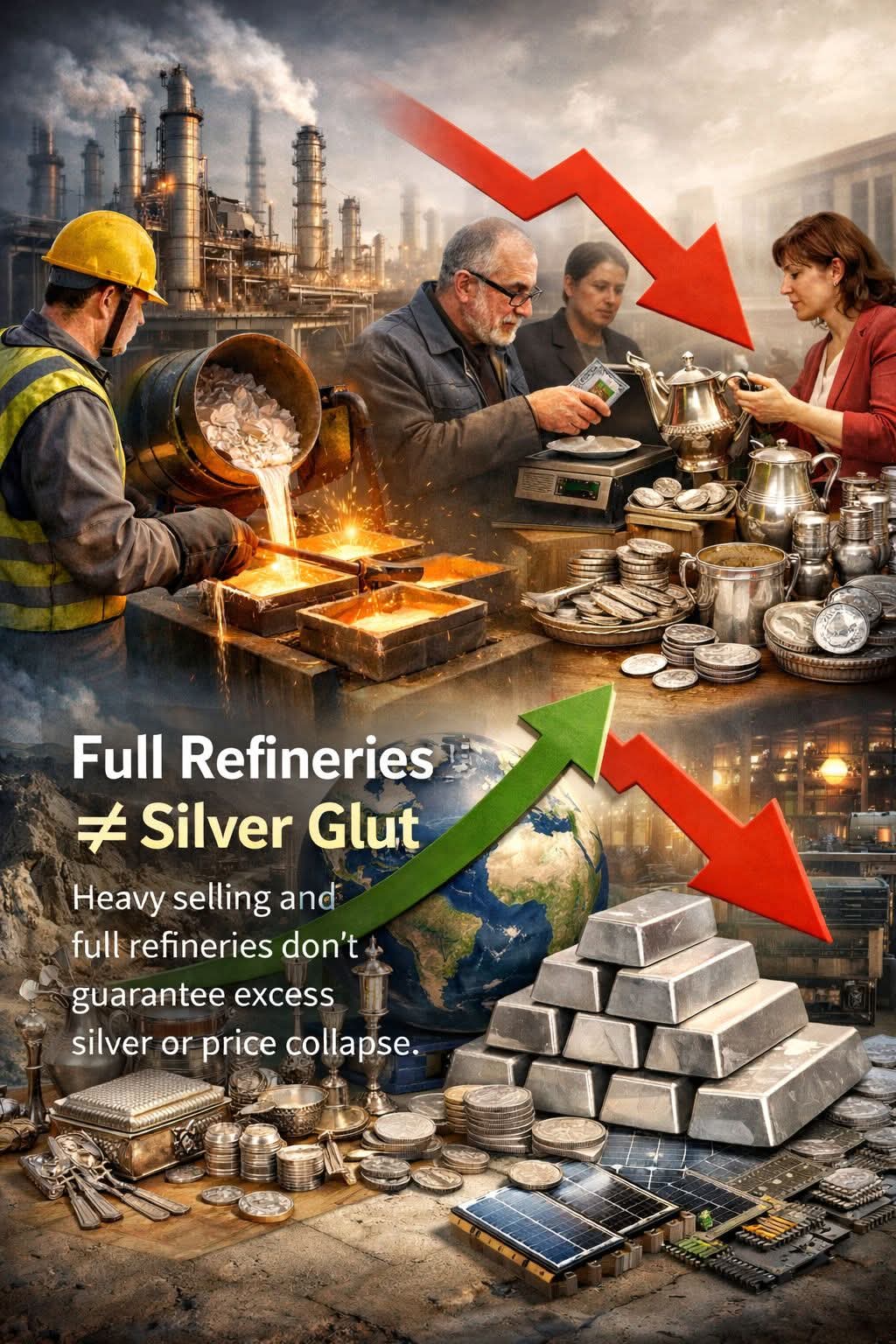
Congested refineries are not evidence of a silver surplus. They mainly reflect limited processing capacity and the fact that supply arrived all at once. Scrap and old silver are not immediately usable — they must be refined first. This creates the illusion of a flood, even though the issue is largely logistical.
Even during a very strong selling wave, the increase in global supply is limited. In practice, we’re talking about tens of millions of ounces, roughly 30 to 80 million, and in extreme cases perhaps around 100 million ounces. Compared to the roughly one billion ounces of silver that move through the market annually, this is not a shift large enough to fundamentally change the balance on its own.
Increased selling is a natural response to a rapid rise in silver prices. Once prices stabilize, the incentive to sell weakens. The selling wave gradually fades, while demand remains. This often leads to buying once again outweighing selling.
It’s also important to look ahead. Some longer-term estimates suggest that by 2026, the silver market could face a deficit of around 300 million ounces. Whether these projections fully materialize or not, they highlight an important point: short-term scrap inflows do nothing to solve the issue of long-term silver availability.
Ultimately, the price of silver is not determined by how many people sell jewelry or cutlery today. What matters is who is willing to pay for physical metal — industry, large traders, and markets where silver is actually consumed. If these buyers absorb the supply, prices do not have to fall, even when selling appears intense and highly visible.
In short: full refineries and heavy selling look dramatic, but on their own they are not proof of excess silver or an inevitable price decline. They often mislead us by focusing on what is immediately visible rather than on the broader reality.
 Silver Dominion
Leave a comment