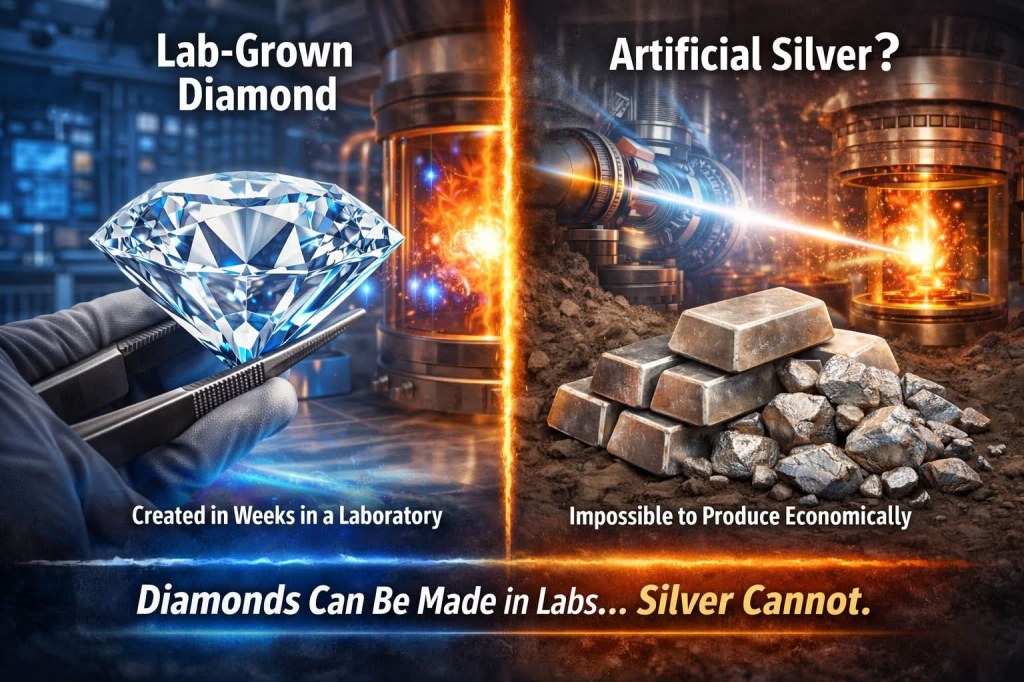
Diamonds were long considered a symbol of rarity and luxury. Modern technology, however, has shown that their uniqueness is not as absolute as people once believed. Today, diamonds can be produced in laboratories.
A laboratory-grown diamond has the same chemical structure and physical properties as a natural diamond—it is the same crystal form of carbon.
The only difference is its origin. While natural diamonds form deep within the Earth’s mantle under extreme pressure and temperature over millions of years, laboratory diamonds can be created within a few weeks using high pressure and temperature or plasma-based methods.
The result is a gemstone that is practically indistinguishable from a natural diamond for an ordinary person, yet often costs significantly less. This fact has strongly influenced the diamond market in recent years.
The situation with silver is completely different. Silver is a chemical element—a metal that was formed during ancient cosmic processes in stars long before the Earth existed. Unlike diamonds, it cannot be economically produced. In theory, silver could be created through nuclear reactions in a reactor or a particle accelerator, but the costs would be so extreme that a single gram of such silver would cost trillions of dollars. And how long would it take to create one gram of silver? Several thousand years of continuous operation.
That is why silver still has to be mined from natural deposits in the Earth’s crust. From this perspective, an interesting paradox emerges: diamonds, considered a luxury symbol of rarity, can now be produced in laboratories, while ordinary silver—used in industry and investments—cannot realistically be manufactured artificially.
This difference shows that the true rarity of a material does not always match how it is perceived in the market.
A simple question at the end:Will silver ever be artificially produced the way diamonds are today?
Answer: No, it will never happen—and if someone claims otherwise, it is fake news.
 Silver Dominion
Leave a comment